Here is an uncomfortable truth that most salon owners in India avoid confronting:
You are probably undercharging.
Not because you are not good enough. Not because your clients will not pay more. But because pricing is uncomfortable it feels personal, it invites comparison, and the fear of losing clients keeps most salon owners stuck at the same rates they charged three years ago.
The result? You are working harder than ever, your costs have gone up rent, products, staff salaries, electricity but your margins are the same or worse. You are busy but not profitable.
Pricing is not just a number on a menu. It is a business strategy. The right pricing model communicates your value, attracts your ideal client, ensures your salon is genuinely profitable, and gives you the financial foundation to grow.
In this blog, we break down exactly how to build a smart salon pricing strategy in India in 2026 from calculating your real costs to understanding pricing psychology and how Skhaira helps you manage, update, and optimise your pricing with confidence.
WHY MOST INDIAN SALON OWNERS PRICE INCORRECTLY
Before building a better pricing strategy, it helps to understand why current pricing is broken for so many salons.
MISTAKE 1: PRICING BASED ON COMPETITION ALONE:
"The salon down the road charges ₹300 for a haircut, so I charge ₹280."
This is the most common pricing mistake in the industry. Competitor-based pricing ignores your actual costs, your quality level, your client experience, and your brand position. If your competitor is also undercharging and most are you are both racing to the bottom together.
MISTAKE 2: NEVER REVISING PRICES:
Many salon owners set their prices when they open and never change them even as rent doubles, product costs increase 30%, and minimum wages rise. A pricing strategy frozen in 2020 is destroying your margins in 2026.
MISTAKE 3: CHARGING THE SAME FOR EVERYTHING:
A basic haircut and a custom balayage are not the same level of service. A junior stylist and a senior stylist with 10 years of experience are not the same. Flat-rate pricing across the board undervalues your premium offerings and your best people.
MISTAKE 4: FEAR OF RAISING PRICES:
"If I raise my prices, clients will leave." This is the most paralysing fear in salon pricing and the least evidence-based. Research consistently shows that a 10 to 15% price increase results in far less client attrition than owners expect. Most loyal clients do not leave over a ₹100 to ₹200 increase. They leave when the experience does not justify the price whatever that price is.
MISTAKE 5: NOT KNOWING YOUR ACTUAL COSTS:
Many salon owners price based on what feels reasonable rather than what the numbers require. If you do not know your cost per service, you cannot know if you are profitable — and you might be losing money on your most popular treatments.
CALCULATE YOUR REAL COST PER SERVICE
This is the most important exercise in salon pricing and most owners have never done it. For every service you offer, your price must cover three layers of cost, plus a healthy profit margin. Here is how to calculate it.
LAYER 1 — DIRECT PRODUCT COST
What products are consumed in delivering this service?
For a basic haircut: shampoo, conditioner, styling product — approximately ₹30 to ₹80 per service.
For a full hair colour: 2 to 3 tubes of colour at ₹200 to ₹400 each, developer, toner, treatment — total product cost ₹600 to ₹1,200 depending on hair length and technique.
Track your product usage carefully for one month. Divide monthly product spend by the number of services delivered. This gives you an accurate product cost per service category.
LAYER 2 — LABOUR COST
How much of a stylist's paid time does this service consume?
If you pay a stylist ₹25,000 per month for 26 working days at 8 hours per day — that is approximately ₹120 per hour.
A keratin treatment takes 3 hours. Labour cost: ₹360.
A basic haircut takes 30 minutes. Labour cost: ₹60.
A bridal package takes 5 hours. Labour cost: ₹600.
For services delivered by senior stylists with higher salaries, adjust accordingly.
LAYER 3 — OVERHEAD ALLOCATION
Every service must carry a share of your fixed costs rent, electricity, water, salon maintenance, software subscriptions, insurance, and marketing.
Calculate your total monthly fixed overheads. Divide by the number of appointments your salon completes in a month. This gives you an overhead cost per appointment.
Example:
Monthly fixed costs: ₹90,000
Monthly appointments: 300
Overhead per appointment: ₹300
THE PRICING FORMULA
Minimum price = Product cost + Labour cost + Overhead allocation
Profitable price = Minimum price ÷ (1 - Target profit margin)
If your target profit margin is 40%:
Minimum cost for keratin: ₹800 + ₹360 + ₹300 = ₹1,460
Profitable price: ₹1,460 ÷ 0.60 = ₹2,433 — round up to ₹2,500 or ₹2,800 based on market position.
This exercise almost always reveals that salons are undercharging on their most time-intensive services particularly colour treatments, keratin, and bridal packages.
UNDERSTAND YOUR MARKET POSITION AND PRICE ACCORDINGLY
Once you know your costs, the next question is: where does your salon sit in the market and where do you want to sit?
Your pricing must be consistent with your positioning. A salon that charges budget prices but provides a premium experience is leaving money on the table. A salon that charges premium prices but delivers a budget experience is losing clients and reputation.
BUDGET / ECONOMY POSITIONING
Target client: Price-sensitive, convenience-focused, high volume
Typical haircut range: ₹150 to ₹400
Strategy: High volume, fast turnaround, minimal customisation
Risk: Thin margins, vulnerable to price competition, difficult to build loyalty
MID-MARKET POSITIONING
Target client: Quality-conscious, value-seeking, regular visitor
Typical haircut range: ₹400 to ₹900
Strategy: Consistent quality, good service experience, moderate range of services
Risk: Most crowded segment — differentiation through experience is critical
PREMIUM POSITIONING
Target client: Experience-driven, less price-sensitive, values expertise
Typical haircut range: ₹900 to ₹2,500+
Strategy: Expert stylists, superior experience, personalised service, strong brand
Risk: Higher client expectations every touchpoint must justify the price
Most salons in India operate in the mid-market segment but charge budget prices — the worst of both worlds. They invest in experience but do not charge for it.
Know where you are. Be honest about whether your pricing matches. And if you want to move upmarket — which is the most sustainable path for growth understand that it requires raising both your prices and your standards together.
BUILD A TIERED PRICING STRUCTURE
Flat-rate pricing is leaving significant revenue on the table. A tiered structure captures more value from the right clients and makes your premium offerings visible and desirable.
TIER BY STYLIST LEVEL
Not every stylist should charge the same rate. Creating stylist tiers serves multiple purposes:
- It rewards your senior team with higher earning potential
- It gives budget-conscious clients a more affordable option (your junior stylists)
- It anchors the value of your best team — clients who choose your Master Stylist feel they are getting a premium experience, not just a service
Example structure:
Junior Stylist: ₹400 to ₹600 haircut
Senior Stylist: ₹700 to ₹1,000 haircut
Master Stylist / Creative Director: ₹1,200 to ₹2,000+ haircut
TIER BY PACKAGE LEVEL
For service categories like colour, treatment, and bridal, create tiered packages:
Essential — covers the core service at your entry price point
Premium — adds a complementary service (e.g., colour + toning + conditioning treatment)
Signature — your top-tier experience with premium products, extra time, personalised consultation
This structure works because it always anchors to your highest tier. When clients see your Signature package first, your Essential package looks reasonably priced — even if it is more than what they would have paid at a flat-rate salon.
PRICE ANCHORING IN PRACTICE
Price anchoring is the psychological principle that people assess value relative to what they see first.
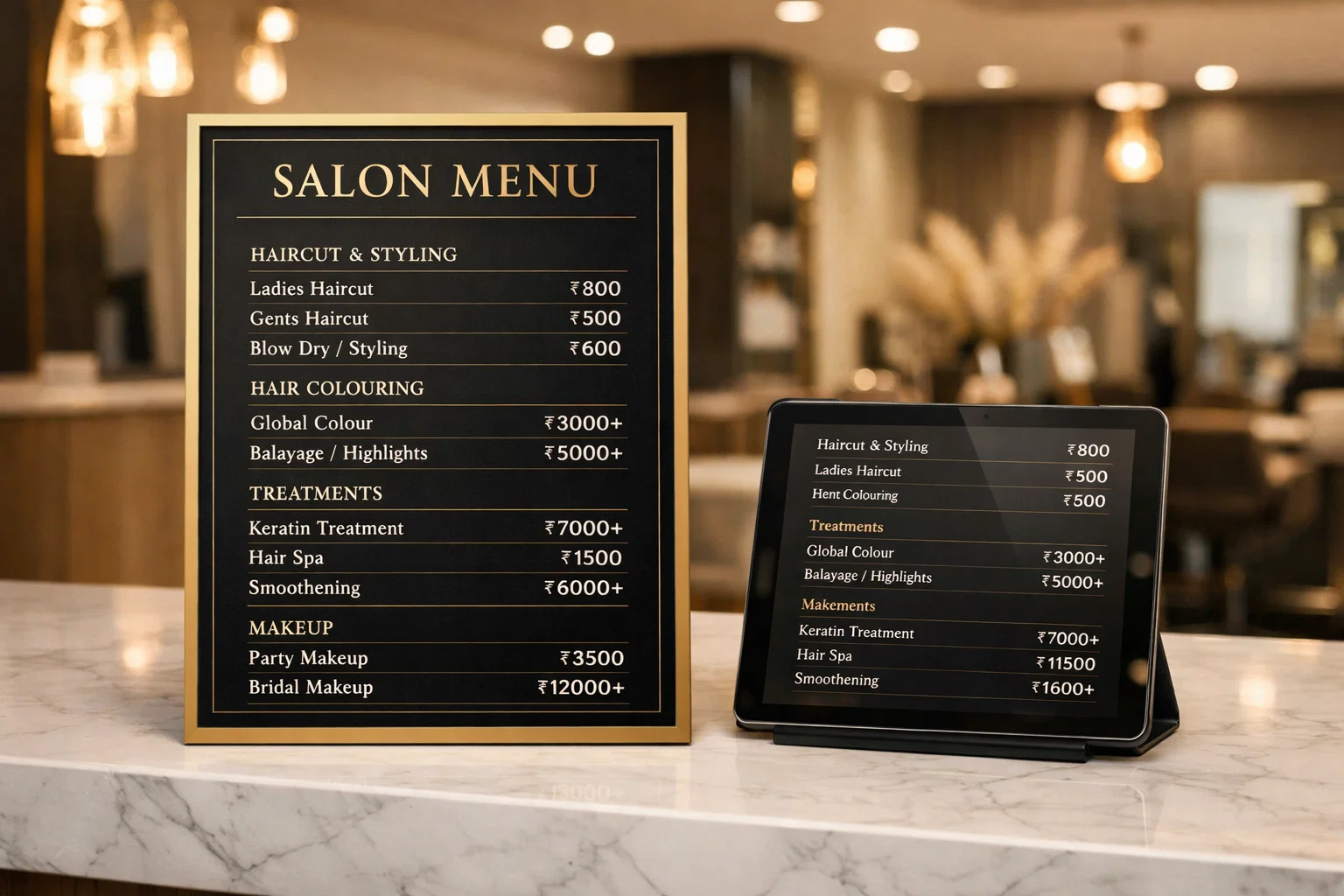
If your menu lists a ₹1,500 keratin treatment at the top and a ₹3,500 treatment below it, the ₹3,500 feels expensive. But if your menu lists ₹5,500 first, then ₹3,500, then ₹1,500 — suddenly ₹3,500 feels like the smart, value-for-money choice. And ₹5,500 makes ₹1,500 accessible to clients who just want the basics.
Structure your menu with your highest-priced options first. This simple change can shift the average bill value significantly without changing a single price.
HOW AND WHEN TO RAISE YOUR PRICES ?
Raising prices is the single most impactful revenue lever available to any salon — and the most avoided.
Here is how to do it without losing the clients you care about.
WHEN TO RAISE YOUR PRICES:
- When your costs have increased — products, rent, staff salaries
- When you are fully booked consistently and turning away clients (this is the clearest signal that you are undercharging)
- Annually at minimum — build price revision into your business calendar every January or April
- When you have invested in your team, your salon, or your brand
HOW MUCH TO RAISE:
A 10 to 20% increase once a year is acceptable and expected. Clients who track prices that closely are often not your most loyal or valuable clients. Most regulars will not notice a ₹100 to ₹200 increase if the experience continues to justify it.
HOW TO COMMUNICATE PRICE INCREASES:
Do not apologise for raising prices. Communicate with warmth and confidence.
Example message to loyal clients:
"As we head into April 2026, we are updating our service prices to reflect the improved experience, products, and team expertise we have invested in over the past year. Our new pricing takes effect from [date]. We are grateful for your loyalty and look forward to continuing to take care of you. Book your last appointment at current rates here:"
This message:
- Gives clients notice and a reason
- Frames the increase as a reflection of quality — not cost pressure
- Creates urgency to book before the change (a revenue boost in itself)
- Ends with a booking link so action is immediate
With Skhaira, updating your service prices takes 30 seconds. Your new menu is live across your booking page, invoices, and reports instantly no printing new menus or updating multiple systems.
USE DYNAMIC PRICING TO FILL SLOW SLOTS
One of the most underused pricing strategies in Indian salons is dynamic pricing charging different rates for the same service at different times.
Your Saturday 3PM slots sell themselves. Your Tuesday 11AM slots sit empty.
Why charge the same price for both?
Dynamic pricing encourages clients to book during your slow periods by offering a modest discount typically 10 to 20% during off-peak hours. This does two things:
1. Fills slots that would otherwise sit empty — any revenue from an otherwise empty chair is pure gain
2. Spreads your booking load — reducing the Saturday rush and improving service quality across the week
HOW TO IMPLEMENT DYNAMIC PRICING ?
In Skhaira, you can create promotional pricing for specific services during defined time windows. Your off-peak discount is visible on the booking page, clearly showing clients the saving available for choosing a less popular time.
Common off-peak windows for Indian salons:
- Weekday mornings: Monday to Friday, 10AM to 1PM
- Post-lunch weekdays: 2PM to 4PM
- Early week: Monday and Tuesday all day
Even a 20 to 30% improvement in weekday utilisation can increase monthly revenue meaningfully — without a single new client.
PACKAGE YOUR SERVICES TO INCREASE AVERAGE BILL VALUE
One of the most effective ways to increase revenue without increasing client volume is smart service packaging. Packages bundle complementary services into a single offering at a slight discount from individual pricing — making the combined purchase feel like a deal to the client while increasing your revenue per visit.
PACKAGE DESIGN PRINCIPLES:
BUNDLE COMPLEMENTARY SERVICES:
A haircut and a blowout naturally go together. A facial and eyebrow threading are often done in the same visit. A colour service and a conditioning treatment are a natural pair. Bundle what clients already combine, and add one service they might not have considered.
PRICE THE PACKAGE BELOW INDIVIDUAL SUM — BUT NOT TOO FAR:
A 10 to 15% saving over individual pricing is the sweet spot. Enough to feel like a deal — not so much that you sacrifice margin significantly.
NAME YOUR PACKAGES EVOCATIVELY:
"Hair Colour Package A" is forgettable. "Weekend Transformation Package" or "Bridal Glow Bundle" or "The Works" creates desire and makes the decision feel exciting rather than transactional.
SEASONAL AND FESTIVE PACKAGES:
Create time-limited packages around Diwali, wedding season, New Year, and summer. These generate urgency, align with natural booking peaks, and give you a reason to communicate with your client list.
With Skhaira, you can create and activate packages with a few clicks, set them live on your booking page, and track how many clients choose them vs individual services — so you know which packages are genuinely driving revenue.
TRACK PRICING PERFORMANCE WITH DATA
The final and most important component of a great pricing strategy is measurement. Pricing is not a set-and-forget decision. It is a living strategy that should be reviewed, tested, and optimised based on real performance data. Skhaira's analytics give you the pricing insights that matter most:
AVERAGE BILL VALUE (ABV):
Track this weekly and monthly. Is it going up or down? An upward trend means your pricing and upselling strategy is working. A downward trend is an early warning sign.
REVENUE PER SERVICE CATEGORY:
Which categories colour, treatments, cuts, retail products generate the most revenue? Are your highest-margin services being promoted effectively in your menu and booking flow?
PACKAGE UPTAKE RATE:
What percentage of clients booking colour are choosing the package vs the standalone service? If uptake is low, is the package visible enough? Is the value clear? Is the price right?
STYLIST REVENUE PER APPOINTMENT:
Are junior stylists' appointments generating significantly less revenue than senior stylists as expected or are the numbers surprisingly close? This tells you whether your tiered pricing is actually directing the right clients to the right stylist level.
SERVICE POPULARITY VS PROFITABILITY:
Your most popular service is not necessarily your most profitable. Use your cost analysis from Section 2 alongside booking volume to identify your highest-profit services and promote them more actively in your menu and marketing.
Review these metrics monthly. Small, data-informed adjustments to your pricing a ₹100 increase here, a package restructure there, a new off-peak discount compound into significant revenue improvement over the course of a year.
Pricing your salon correctly is one of the most powerful things you can do for your business and it costs nothing to change. The salons that thrive in India in 2026 are not necessarily the most skilled or the best located. They are the ones that understand their costs, know their value, price with confidence, and use data to continuously optimise.
You do not have to compete on price. You have to compete on value and then charge for that value unapologetically. Whether it is calculating your true cost per service, building a tiered menu, implementing dynamic pricing for slow slots, or launching seasonal packages every strategy in this blog is available to you right now, without any additional investment.
And with Skhaira, every pricing update goes live instantly, every package is trackable, and every revenue report tells you exactly how your pricing is performing so you can keep improving, keep growing, and keep your salon genuinely profitable.
Because a busy salon that is not profitable is just an expensive hobby. A well-priced salon is a business.