She gave two weeks notice, took her client list with her and three of your regulars followed her to the new salon down the road. This is not just a staffing problem. It is a revenue problem. Industry research suggests that 25 to 40% of a stylist's clients will follow them when they leave. For a stylist generating ₹1.5 lakhs per month in revenue, that is ₹37,500 to ₹60,000 in monthly revenue walking out the door with her.
And replacing her? The total cost of replacing a single mid-level stylist recruitment, training, lost revenue, and client attrition can easily exceed ₹2 to ₹4 lakhs.
High staff attrition is one of the most expensive problems in the Indian salon industry. Many salon owners report high attrition rates and inconsistent service delivery due to training gaps. And in 2026, the competition for skilled stylists has never been fiercer new salon openings, booth rentals, and independent freelancing are giving your best people more options than ever.
The solution is not higher pay alone. It is culture.
Stylists want to feel seen, valued, and supported not just managed. When culture takes a back seat, communication breaks down and motivation dips. When culture is strong, your salon becomes the place ambitious stylists want to build their career not leave.
Understand why salon staff actually leaves
Before you can fix retention, you need to understand what is actually driving your team out the door. Most salon owners assume staff leave for more money. Sometimes that is true. But research from India's salon industry tells a more nuanced story.
Apart from untimely salary payments, the contributing factors for staff attrition include operational issues on the shop floor, lack of growth opportunities, and environments where staff do not feel valued or respected.
The real reasons your stylists leave:
1. Salary paid late or calculated unfairly:
This is the single biggest driver of attrition in Indian salons. A stylist who is unsure whether her commission has been correctly calculated or who has to wait until the 10th for a salary that should arrive on the 1st loses trust quickly. And once trust is gone, the exit follows.
2. No visible career path:
A junior stylist who cannot see a clear route to becoming Senior Stylist and then Creative Director will leave for a salon that offers that ladder. Without a structured growth path, your best junior talent plateaus, gets frustrated, and goes.
3. Toxic team dynamics:
One high-earning stylist who treats junior staff badly, gossips, or creates cliques destroys morale silently but powerfully. Protecting your culture is more important than protecting a single high-earning chair. A toxic environment drives away your best upcoming talent and eventually alienates your clients.
4. No recognition or appreciation:
Stylists who deliver excellent work every day and never hear "well done" not once stop caring about excellence. Recognition is not expensive. It is essential.
5. Rigid scheduling with no flexibility:
In 2026, the biggest threat to your salon is not the competitor across the street it is more flexible settings. Stylists are leaving traditional salons for booth rentals because they crave autonomy. The traditional Tuesday to Saturday, 9AM to 6PM schedule is a retention killer for the modern workforce.
Pay fairly, transparently, and on time every single month
The foundation of every great salon culture is simple: pay your people correctly, transparently, and on time. This sounds obvious. Yet it is the most commonly violated principle in Indian salons and the root cause of more resignations than any other single issue.
WHAT FAIR AND TRANSPARENT PAY LOOKS LIKE:
Commission structures that are clear upfront:
Commission structure is the most common source of conflict between salon owners and their teams. Get it right and it becomes your strongest retention tool. Get it wrong and it becomes the reason your best people leave.
Every stylist should know in writing exactly how their commission is calculated. What percentage of which services. How retail sales commissions work. What the bonus threshold is. No ambiguity. No surprises at month end.
Tiered incentives that reward performance:
Stylists earn more as they hit higher sales or booking milestones. Example: 35% base → 40% after ₹50,000 monthly services → 45% after ₹80,000. This structure gives every stylist a reason to grow their client base and upsell because the benefit is directly theirs.
On-time salary payments non-negotiable:
Set a fixed salary date and never miss it. A stylist should never have to ask where her money is. This single discipline builds more trust than any team event or recognition programme.
Use Skhaira to eliminate commission disputes:
Skhaira automatically calculates commission for every stylist based on the rules you define service by service, rupee by rupee. Every stylist can see exactly what they earned and why. No disputes. No "I think you calculated that wrong." No mistrust. For a complete staff management and commission framework, refer to: How to Manage Salon Staff Effectively with Software.
Create a career path not just a job
Showcase career growth by promoting internal training, mentorship, and leadership paths. A stylist who can see the next five years of her career at your salon has no reason to look elsewhere.
BUILD A FOUR-RUNG CAREER LADDER:
Junior Stylist (0 to 12 months):
Learning phase. Assisting senior stylists. Handling simpler services independently. Enrolled in your 90-day onboarding programme. Clear criteria for what promotion to Senior looks like.
Senior Stylist (1 to 3 years):
Full independent service delivery. Higher commission tier. Mentoring junior team members. Client base of 40+ regulars. Access to external brand training.
Creative Director / Specialist (3 to 5 years):
Leads technical education within the team. Handles the most complex colour and treatment work. Featured on the salon's Instagram as a specialist. Premium commission and performance bonus.
Salon Manager / Brand Ambassador (5+ years):
Operational leadership. Client relationship management. Possible equity or profit-sharing conversation. The pinnacle and the reason your best people want to stay.
Document this ladder clearly. Share it with every team member at onboarding. Review progress together at every monthly check-in. When a stylist knows exactly what she is working toward and what it will earn her she stays.
Replace management with mentorship
In 2026, the term "boss" is becoming obsolete in the beauty industry. Top-tier stylists do not want to be managed they want to be mentored. Salon staff management is now a service you provide to your team to help them reach their full potential. The shift from manager to mentor is the single most powerful cultural transformation a salon owner can make.
WHAT MENTORSHIP LOOKS LIKE IN PRACTICE:
Monthly 1-on-1 pulse meetings (15 to 20 minutes):
Schedule 15-to-30-minute individual meetings every month. Ask: "What was your biggest win this month?" and "What hurdle can I remove for you in the next 30 days?" When a stylist feels you are actively helping them make more money, they stop looking for the exit. These are not performance reviews. They are conversations. The difference matters enormously.
Coach with data not impressions:
Salons improve retention rates by 15% just by using data to coach their teams during weekly meeting managing with real numbers, not gut feelings.
Skhaira gives you real data for every stylist revenue generated, client retention rate, rebooking rate, average bill value, client ratings. Walk into every coaching conversation with facts, not feelings. "Your rebooking rate improved from 38% to 52% this month that is excellent growth. Let us talk about how to push it to 60% next month." For a complete data framework, refer to: How to Use Data to Grow Your Salon Business.
Invest in their skills:
Send stylists to brand training. Pay for an external masterclass. Sponsor a certification. Invest in ongoing education send team members to workshops, brand training sessions, and industry events. The knowledge they bring back improves your salon's service quality, and the investment demonstrates that you are committed to their growth.
When you invest in a stylist's skills, you are telling her: "You are worth investing in. I see a future here for you." That message retains people.
Recognise performance publicly and consistently
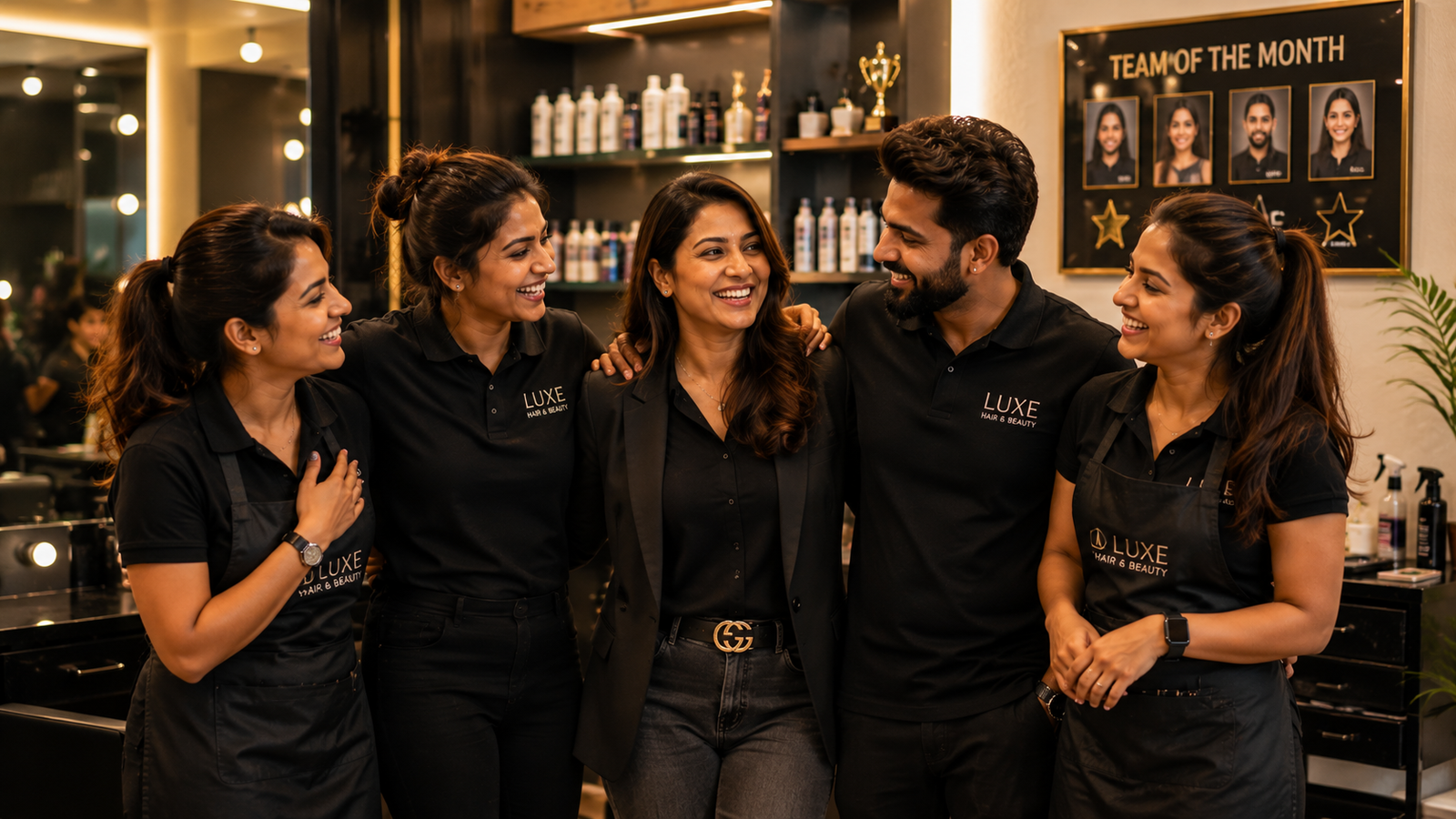
Recognition costs nothing. Its absence costs everything. Public recognition celebrating achievements like highest revenue, best client retention, most positive reviews, most improved in team meetings and on social media has enormous impact on morale. Recognition costs nothing but has enormous impact.
RECOGNITION PRACTICES THAT BUILD CULTURE:
Stylist of the Month:
A simple framed certificate presented at the team meeting. Announced on your Instagram Stories with a personal caption about why this stylist won it. A small cash bonus or gift voucher if budget allows. The effect on the winner and on every other team member watching is disproportionate to the cost.
Team meeting wins board:
Start every Monday morning meeting with "wins from last week." Each team member shares one win a client who said something wonderful, a service they are proud of, a personal milestone. This takes 5 minutes and sets a positive, collaborative tone for the week.
Catch people doing things right:
Most feedback in salons is corrective "you did X wrong." Actively look for things your team is doing well and mention them specifically and immediately. "Priya, the way you handled that nervous client today was exceptional she told me on her way out."
Specific, timely, genuine recognition builds the kind of loyalty that no competitor's salary offer can buy.
Build flexibility into your salon schedule
Implement morning and evening shifts. This allows the salon to stay open longer capturing more revenue while giving stylists the mornings or afternoons off for their personal lives.
Flexibility is not softness. It is strategy. A stylist who has control over her schedule who can swap a shift when her child is sick, who gets one fixed day off that never gets cancelled, who does not feel trapped by rigid working hours is a stylist who is not looking for the exit.
PRACTICAL FLEXIBILITY IN INDIAN SALONS:
Two shift system: Morning (9AM to 3PM) and afternoon (1PM to 7PM) with one hour overlap. Stylists choose their primary shift. The salon covers longer hours and pays for fewer full-day hours.
Fixed weekly day off: Every stylist has one guaranteed day off per week. Non-negotiable. Published in the schedule at the start of the month. Never cancelled without mutual agreement.
One planned leave month per year: Allow each stylist to plan one week of leave per year in advance. This respects their personal lives and significantly reduces unplanned sick days.
Digital leave requests through Skhaira: Staff submit leave requests through the app. You approve or decline from your dashboard. The schedule updates automatically no double bookings, no confusion. For complete staff scheduling guidance, refer to: How to Train New Salon Staff and Maintain Quality.
Protect your culture from toxic behaviour
Culture is not a poster on the wall it is the set of behaviours you reward and the behaviours you tolerate. To build a high-performance team, you must define your non-negotiables.
Every salon has a stylist who is technically excellent but culturally destructive. She gossips. She talks down to junior staff. She complains about clients loudly enough for others to hear. She refuses to help with salon tasks that are "beneath her."
The mistake most salon owners make is tolerating this behaviour because the stylist brings in high revenue. This is one of the most expensive mistakes in salon management.
The stylist who is toxic costs you three times what she earns:
- She drives away junior staff who are watching her behaviour as a signal of what is acceptable
- She damages the client experience through her attitude
- She eventually drives away the clients she has built loyalty with when she leaves, they follow her
How to address toxic behaviour
Set your non-negotiables in writing your team's behavioural standards and values. Share them at onboarding and review them at every team meeting.
When a non-negotiable is violated have the conversation immediately, privately, and specifically. Not "your attitude needs to improve" but "when you said X to a junior stylist in front of a client today, it is not acceptable here and here is why."
Give one clear warning. Document it. If the behaviour continues, the right decision is clear regardless of the revenue she generates. A salon that loses one toxic high-earner and keeps five motivated, values-aligned stylists will outperform any alternative arrangement every time.
The growth of the beauty industry depends solely on keeping staff highly motivated as they generate referrals, deliver client expectations, and provide service, thereby boosting salon profits. Motivated staff equals efficient service and a creative approach compared to disengaged staff whose performance impacts revenue.