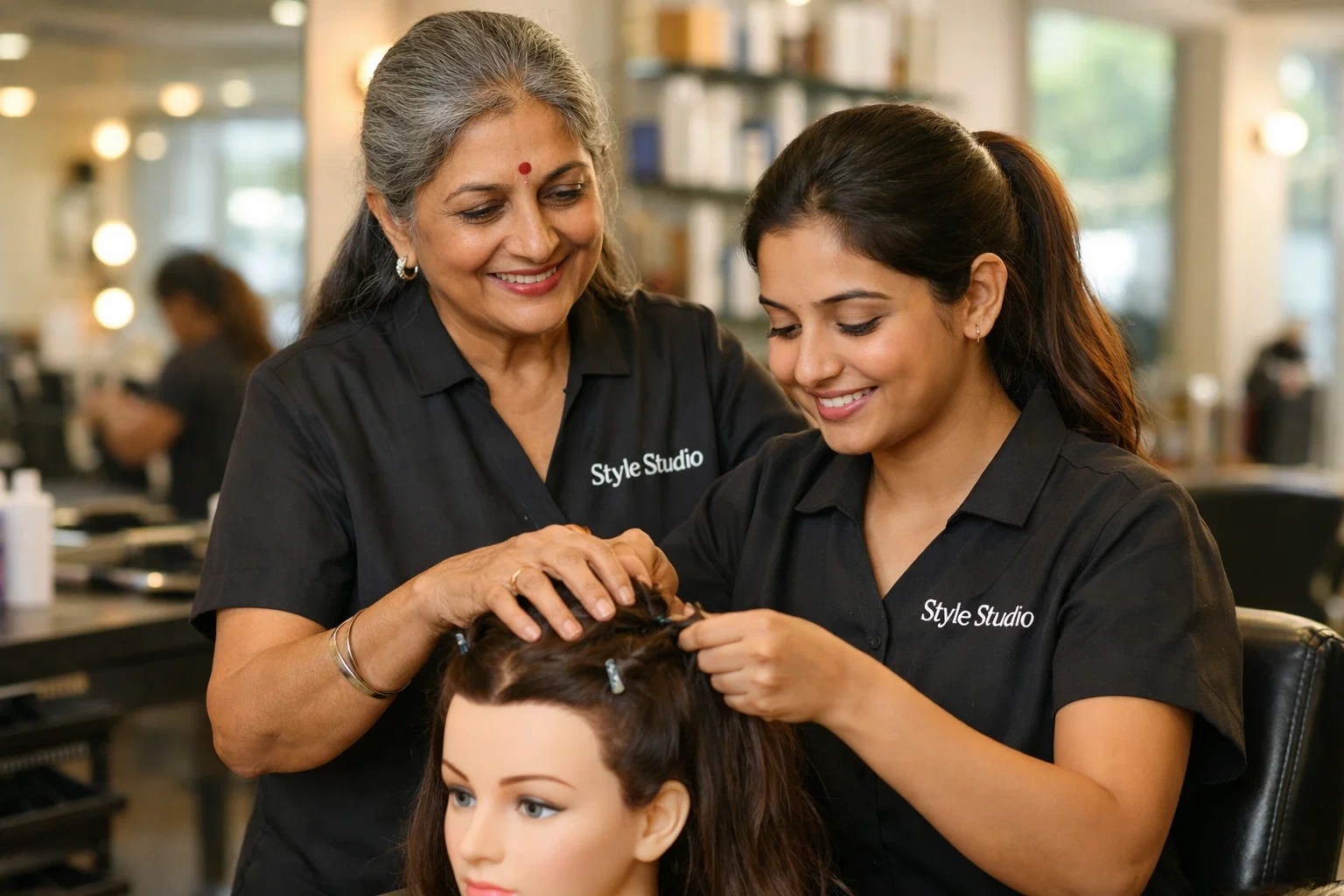
The quality of your salon is not defined by your own skills. It is defined by the consistent quality of every person on your team, on every day, with every client. One undertrained stylist can undo months of brand building with a handful of bad experiences.
The salons that maintain exceptional quality as they grow are not the ones with the most talented hires. They are the ones with the best training systems structured onboarding, clear standards, ongoing development, and the tools to track and measure performance over time.
In this blog, we cover exactly how to build a salon training programme that creates consistent quality across your entire team and how Skhaira helps you measure whether your training is actually working.
WHY MOST SALON TRAINING FAILS
Before building a better system, it is worth understanding why training breaks down in most salons.
PROBLEM 1: NO STRUCTURED PLAN:
Most salons have no written training programme. New staff are told to "watch and learn" shadowing senior stylists with no clear curriculum, no milestones, and no way to know when they are ready to work independently. Learning happens by chance, not by design.
PROBLEM 2: TRAINING IS TREATED AS LOST REVENUE:
Many salon owners rush new staff onto the floor as quickly as possible because a training stylist is not a billing stylist. This short-term thinking creates long-term quality problems. A stylist who is not fully trained will cost you in re-dos, client complaints, and eventually, lost regulars.
PROBLEM 3: STANDARDS EXIST ONLY IN THE OWNER'S HEAD:
"Do it the way I do it" is not a training standard. If your expectations are not written down exactly how a consultation should be conducted, how a shampoo should be done, how a client should be greeted — they cannot be taught consistently or measured objectively.
PROBLEM 4: TRAINING STOPS AFTER ONBOARDING:
Even the salons that do structured onboarding often treat it as a one-time event. New staff are onboarded and then left to develop or not on their own. Without ongoing coaching, performance plateaus and bad habits solidify.
PROBLEM 5: NO FEEDBACK LOOP:
Most stylists receive feedback only when something goes wrong. Without regular, constructive performance reviews tied to real data client ratings, rebooking rates, revenue generated staff do not know where they stand or what to improve.
Each of these problems is solvable and the solution starts with building a training system, not just hiring good people and hoping for the best.
BUILD YOUR SALON SERVICE STANDARDS BIBLE
Before you can train anyone, you need to know and document exactly what you are training them to do. Your Service Standards Bible is your salon's operational DNA. It captures every standard, every process, and every expectation in writing so that training is consistent regardless of who delivers it, and quality can be maintained regardless of who is on the floor.
WHAT YOUR STANDARDS BIBLE SHOULD COVER:
CLIENT EXPERIENCE STANDARDS
The Greeting: Exactly how a client is welcomed by name if possible, within how many seconds of entering, with what words, and with what body language.
The Consultation: The exact questions to ask before every service. What information to gather. How to understand what the client actually wants vs what she is asking for. How to manage expectations for results that may not be achievable in one session.
The Service Delivery: Step-by-step process standards for each service category not just the technical steps, but the client experience during the service. Is the stylist communicating what she is doing? Offering a magazine or beverage?
The Finish: How every service ends the hand mirror reveal, the product recommendation, the rebooking invitation, the farewell.
TECHNICAL STANDARDS
Document the technical standards for every service your salon offers:
- The exact products used and why
- Sectioning and application techniques for colour services
- Timing standards — how long each service should take
- Quality checkpoints — what the result should look like before the client leaves the chair
SALON PRESENTATION STANDARDS
How the salon should look at all times cleanliness of stations, floor, mirrors, and washbasins. How tools should be stored and sanitised. How products should be organised at the styling station. What the reception desk should and should not have on it.
COMMUNICATION STANDARDS
How staff respond to client messages response time, tone, language. How to handle a complaint in person. How to communicate a delay or a problem to a waiting client.
This document does not need to be a hundred pages. A well-organised 20 to 30 page standards guide covers everything your team needs and gives new staff a reference they can return to independently.
DESIGN A STRUCTURED 30-60-90 DAY ONBOARDING PROGRAMME
Great training is not a day it is a journey. A structured 90-day onboarding programme gives new staff the time and support they need to reach your standards without being rushed or left to figure it out alone.
DAYS 1 TO 30 — OBSERVE, ASSIST, AND ABSORB
Week 1: Orientation
- Walk through the salon — every station, every product, every piece of equipment
- Read the Service Standards Bible — cover to cover
- Shadow the owner or most senior stylist for every appointment
- Learn the Skhaira booking system — how to check in clients, manage the schedule, and process payments
Week 2 to 4: Assist and Observe
- Assist senior stylists during services — shampoos, blowouts, product mixing
- Observe consultations and client interactions closely
- Begin performing basic services on willing walk-in clients under direct supervision
- End-of-week check-in with the manager — what has been learned, what feels unclear
MILESTONE AT DAY 30:
A structured review with the manager covering: product knowledge, salon familiarity, client communication basics, and readiness to move to supervised independent delivery.
DAYS 31 TO 60 — SUPERVISED INDEPENDENT DELIVERY
The new stylist begins taking her own clients for a defined service range starting with simpler services and expanding as competence is demonstrated.
A senior stylist or the manager checks in on each appointment not hovering, but available. Client feedback is collected after every service via Skhaira's post-visit rating. Any negative feedback is reviewed immediately and addressed constructively.
Weekly one-on-one sessions focus on:
- Reviewing client ratings and feedback from the week
- Identifying one technical skill to improve
- Reviewing rebooking rate — are her first-time clients coming back?
MILESTONE AT DAY 60:
A formal mid-point review assessing technical quality, client satisfaction scores, and professional conduct. The stylist receives honest, evidence-based feedback — and a clear development plan for the final 30 days.
DAYS 61 TO 90 — GROWING INDEPENDENCE
The stylist is now handling her full service range independently. The manager steps back from daily check-ins but remains accessible.
Focus shifts to:
- Upselling and recommending complementary services
- Building personal client relationships and achieving a strong rebooking rate
- Technical development in more complex services — colour, treatments
- Contributing to the team — supporting junior colleagues, maintaining salon standards
MILESTONE AT DAY 90:
The 90-day performance review. Using Skhaira's data — revenue generated, client retention rate, average bill value, and client ratings — this review is objective, fair, and forward-looking. Set targets for the next quarter and discuss the path to a more senior role.
ASSIGN A MENTOR NOT JUST A MANAGER
The fastest way a new stylist learns is not from a training manual or a formal session. It is from a trusted senior colleague who is invested in their growth.
Assigning a dedicated mentor a senior stylist who takes personal responsibility for the new team member's development accelerates learning dramatically and improves first-year retention significantly.
WHAT A SALON MENTOR DOES:
- Answers questions without making the new stylist feel stupid for asking
- Demonstrates techniques in real time on real clients
- Debrief after difficult appointments — what happened, what could have been done differently
- Advocates for the new stylist in team meetings — identifying their strengths and growth areas honestly
- Models the salon's culture — how to interact with clients, how to handle problems, how to behave as a professional
WHAT A SALON MENTOR IS NOT:
- A babysitter who does the new stylist's job for them
- A replacement for formal training or manager feedback
- An unpaid additional responsibility with no recognition
Acknowledge your mentors. Give them a small incentive a monthly bonus, a title like "Senior Trainer," or simply consistent public recognition. People invest more deeply in mentoring when it is valued visibly.
BUILD AN ONGOING LEARNING CULTURE
Onboarding gets a new stylist to your standard. Ongoing learning keeps your entire team improving and gives your best people a reason to stay.
The salons that retain great staff for 3, 5, and 10 years are the ones that invest continuously in their team's growth. Here is how to build a learning culture without a training budget that breaks the bank.
WEEKLY TEAM HUDDLES (15 MINUTES):
Every Monday morning before the salon opens a 15-minute standing team meeting. Share one piece of learning, one client feedback highlight, one goal for the week. This creates consistency, communication, and a sense of shared purpose.
MONTHLY SKILL WORKSHOPS (90 MINUTES):
Once a month, close the salon 90 minutes early or use a quiet morning for a focused technical session. Topics rotate balayage techniques, consultation skills, upselling language, skin analysis. Invite a brand educator from one of your product suppliers — most premium brands like Wella, L'Oreal, and Schwarzkopf offer free technical training for salons that stock their products.
QUARTERLY EXTERNAL TRAINING:
Invest in at least one external training day per quarter for your team a masterclass, a trade show, a brand academy session, or a skills workshop. The cost is real but the return in improved quality, team motivation, and retention is significantly higher.
INDIVIDUAL DEVELOPMENT PLANS:
Every team member should have a written development plan — updated quarterly — that identifies where they are now, where they want to be in 12 months, and what training and support will help them get there. This makes staff feel seen and invested in — the two most powerful retention tools available.
USE DATA TO MEASURE TRAINING EFFECTIVENESS
Training without measurement is guesswork. How do you know if your 90-day programme is actually working? How do you identify which team members need more support before a client complains?
Skhaira's performance analytics answer these questions with real data.
CLIENT SATISFACTION SCORES:
After every appointment, Skhaira sends an automatic post-visit rating request. Track each stylist's satisfaction score week over week. A new stylist's scores should improve consistently through the 90-day programme. If they plateau or decline, it is a signal to intervene early.
REBOOKING RATE:
What percentage of a new stylist's first-time clients book a second appointment? This is the clearest measure of whether clients trust and enjoy her work. A healthy rebooking rate at 90 days is 40 to 50%. Below 30% requires immediate coaching focus.
REVENUE PER APPOINTMENT:
Is the new stylist recommending complementary services? Is her average bill value growing as she becomes more confident in upselling? Stagnant or low ABV after 60 days suggests her consultation and recommendation skills need development.
NO-SHOW AND CANCELLATION RATES:
A high no-show rate linked to a specific stylist can indicate that clients are not excited enough about their appointment to protect it. This is a softer signal but worth monitoring.
COMPARISON TO TEAM BENCHMARKS:
Compare each stylist's metrics against your salon's averages. Not to penalise outliers, but to understand who is above benchmark and can be recognised and who is below and needs support.
With Skhaira, these reports are generated automatically. You do not need to build spreadsheets or track manually. The data is simply there every day, for every team member ready to inform your next coaching conversation.
HANDLE PERFORMANCE PROBLEMS EARLY AND CONSTRUCTIVELY
Even with great training, some team members will struggle. How you handle performance problems early determines whether a struggling stylist improves or becomes a bigger problem.
A client complaint that goes unaddressed becomes a pattern. A technique that is slightly off and never corrected becomes the standard. Most performance problems are fixable at the early stage and unfixable once they are entrenched.
HOW TO HAVE A CONSTRUCTIVE PERFORMANCE CONVERSATION:
PREPARE WITH DATA:
Before the conversation, pull the stylist's Skhaira metrics specific client ratings, specific feedback, specific rebooking numbers. You are not sharing impressions or opinions — you are reviewing evidence together.
LEAD WITH CURIOSITY, NOT ACCUSATION:
"I have noticed your rebooking rate has been around 25% this month what do you think is happening in those appointments?" invites self-reflection. "Your clients are not coming back" invites defensiveness.
BE SPECIFIC ABOUT WHAT NEEDS TO CHANGE:
"I need you to improve your client interactions" is useless feedback. "During your consultations, I want you to ask the client three specific questions before picking up your scissors — let me show you exactly what I mean" is actionable.
SET A CLEAR TIMELINE AND FOLLOW UP:
Agree on what improvement looks like and when you will review again. Follow through. If improvement does not happen within the agreed timeline despite support, have an honest conversation about whether this role is the right fit.
DOCUMENT EVERY CONVERSATION:
Write a brief note after every performance conversation what was discussed, what was agreed, and the timeline. This protects you legally and creates a clear record of the support you provided.
RETAIN YOUR BEST STAFF THROUGH GROWTH AND RECOGNITION
Training your team is an investment. Retaining the staff you have trained is how you protect that investment.
The cost of losing a trained stylist recruitment, rehiring, retraining, the clients she takes with her is significant. The salons with the lowest staff turnover are the ones that make their people feel valued, challenged, and growing.
RECOGNISE PERFORMANCE PUBLICLY:
A "Stylist of the Month" board in your salon. A public shoutout in your team WhatsApp group. A featured post on your Instagram introducing a team member and her work. Public recognition costs nothing and means everything.
CREATE CLEAR CAREER PATHS:
Junior Stylist → Senior Stylist → Master Stylist / Creative Director → Salon Manager. When staff can see the path ahead — and the criteria to move along it — they stay and work toward it. When there is no path, they look for one elsewhere.
INVEST IN THEIR PROFESSIONAL GROWTH:
Pay for external training. Send your best stylist to a brand masterclass. Sponsor a senior team member's advanced colour certification. When you invest in someone's skills, they feel a professional loyalty that salary alone cannot create.
REWARD LOYALTY FINANCIALLY:
Annual salary reviews tied to performance data. A loyalty bonus for stylists who complete 2, 3, or 5 years with your salon. Commission structures that reward growth in revenue and retention. Financial loyalty rewards signal that you see your team as long-term partners, not interchangeable employees.
LISTEN AND ACT:
Ask your team what they need — better products, more training, a different schedule, improved facilities. Then act on what you hear. Stylists who feel heard stay. Stylists who feel invisible leave — and they often take their loyal clients with them.
The quality of your salon is a direct reflection of the quality of your team. And the quality of your team is a direct reflection of how much you invest in training, developing, and retaining them.
Great stylists do not just appear. They are built through structured onboarding, clear standards, ongoing learning, honest feedback, and genuine investment in their growth. The salon owners who understand this do not struggle with inconsistent quality or high turnover. They build teams that become their biggest competitive advantage.
Skhaira supports your team management at every stage from tracking a new stylist's 90-day performance data to monitoring your senior team's rebooking rates and revenue contribution. With the right data, every training decision becomes smarter, every coaching conversation becomes more productive, and every investment in your team delivers a measurable return.